
Reputation is often treated as a fixed outcome. A score is assigned, reviews accumulate, and perception settles into place. In reality, trust does not work that way.
Customer perception changes continuously. Businesses improve, customer expectations shift, and experiences evolve over time. A modern reputation system should reflect that movement instead of freezing credibility into a static number.
The future of digital credibility belongs to systems that adapt through real feedback, not systems that rely only on first impressions.
Why Static Reputation Models Fall Short
Traditional review platforms tend to present reputation as a permanent snapshot. Once a business accumulates enough reviews, the overall perception often becomes difficult to change, even when the business evolves.
This creates several problems:
- Early reviews can disproportionately shape long-term perception
- Improvements in service quality may take too long to reflect
- Temporary issues can distort credibility without context
- Businesses are measured by historical averages instead of current performance
A reputation system that cannot adapt over time becomes less accurate as businesses and customer experiences continue to change.
Reputation Should Evolve with Evidence
Trust is not established in a single moment. It develops through consistency, responsiveness, and real customer experience.
That means reputation systems should not simply collect reviews. They should continuously interpret and evolve from them.
A dynamic reputation model allows credibility to:
- Strengthen through positive customer experiences
- Adjust when service quality changes
- Reflect patterns instead of isolated events
- Represent ongoing business performance more accurately
This creates a reputation framework that remains connected to reality instead of becoming disconnected from current customer sentiment.
The Role of AI Baseline Ratings
One of the biggest challenges in reputation systems appears at the very beginning. New businesses often enter the market without reviews, context, or visible credibility.
This creates uncertainty for customers and slows trust formation before meaningful feedback has even had the chance to develop.
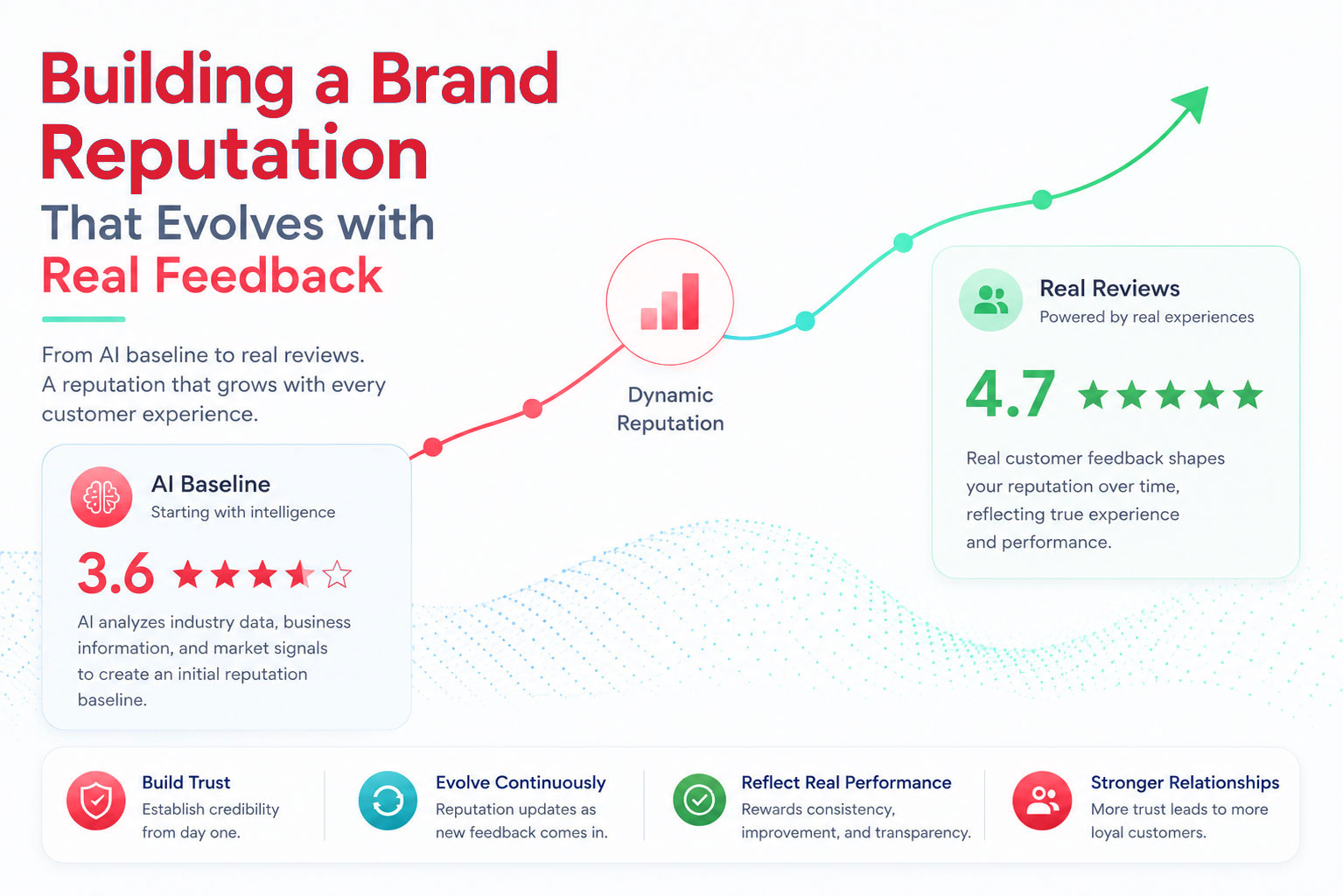
An AI-informed baseline rating helps solve this early-stage gap by providing an initial layer of context before customer reviews are submitted.
The baseline is not designed to replace customer feedback. It exists to establish a structured starting point that can evolve naturally as real experiences are collected.
This approach allows reputation to begin with context instead of silence.
From Baseline to Real Customer Experience
As customer reviews are added, the reputation system transitions from an initial AI-supported foundation into a continuously evolving credibility model.
Real feedback becomes the defining force behind the reputation over time.
This transition is important because it creates balance:
- AI provides early structure
- Customers validate and refine reputation through experience
- The system adapts dynamically instead of remaining static
The result is not a reputation score that stays frozen. It becomes a living reflection of customer experience as it develops.
Why Dynamic Reputation Matters for Businesses
Businesses should not be permanently defined by their earliest stage. Growth, improvement, and consistency should influence how credibility develops over time.
A dynamic reputation system encourages businesses to:
- Prioritize long-term customer satisfaction
- Respond to feedback constructively
- Improve operational quality continuously
- Build trust through sustained performance
Instead of rewarding visibility alone, evolving reputation systems reward consistency and accountability.
Why Dynamic Reputation Matters for Customers
Customers benefit from reputation systems that reflect change instead of preserving outdated perception.
A dynamic system helps users:
- See whether a business is improving or declining
- Understand patterns behind customer sentiment
- Make decisions using more current information
- Trust that reputation reflects ongoing reality
This creates a more reliable decision-making environment where credibility is continuously earned rather than assumed.
Building Reputation Through Transparency
For reputation systems to remain credible, transparency must remain central to the process.
Customers should understand:
- How ratings evolve over time
- How customer feedback influences reputation
- How AI contributes to early-stage context
- Why credibility should adapt with evidence
Transparent systems strengthen confidence because they allow reputation to be understood, not simply displayed.
Where Trustaine Fits In
Trustaine approaches reputation as a continuously evolving system rather than a static score.
By combining AI-informed baseline ratings with authentic customer feedback, the platform creates a reputation model that develops alongside real business performance.
This allows businesses to establish early credibility while ensuring that long-term reputation remains shaped by real customer experience.
The goal is not to automate trust. The goal is to structure credibility in a way that remains transparent, adaptive, and grounded in reality.
Reputation as a Living System
The future of digital credibility will belong to systems that evolve with evidence instead of remaining fixed in time.
Reputation should not be defined by a single moment, a single review, or a static score.
It should reflect how businesses perform consistently, how customers experience them over time, and how trust develops through ongoing interaction.
When reputation evolves with real feedback, credibility becomes more than visibility. It becomes a reliable signal customers can confidently act on.