
Customers have more choices than ever before. Whether selecting a service provider, purchasing a product, or evaluating a brand, decisions are often made within minutes. In that short period of time, people look for signals that help them determine whether a business is trustworthy.
Many organizations assume that a high rating alone is enough to inspire confidence. In reality, customers evaluate credibility through a combination of factors that extend far beyond a single score.
Understanding these trust signals is essential for businesses that want to build lasting credibility and stronger customer relationships.
Why Trust Signals Matter
Trust signals help reduce uncertainty. Before making a decision, customers naturally look for evidence that supports their confidence in a business.
When clear trust signals are present, people feel more comfortable moving forward. When those signals are missing, hesitation increases and decision making becomes more difficult.
In competitive markets, trust signals often become the difference between being considered and being chosen.
Trust Is Built Through Multiple Signals
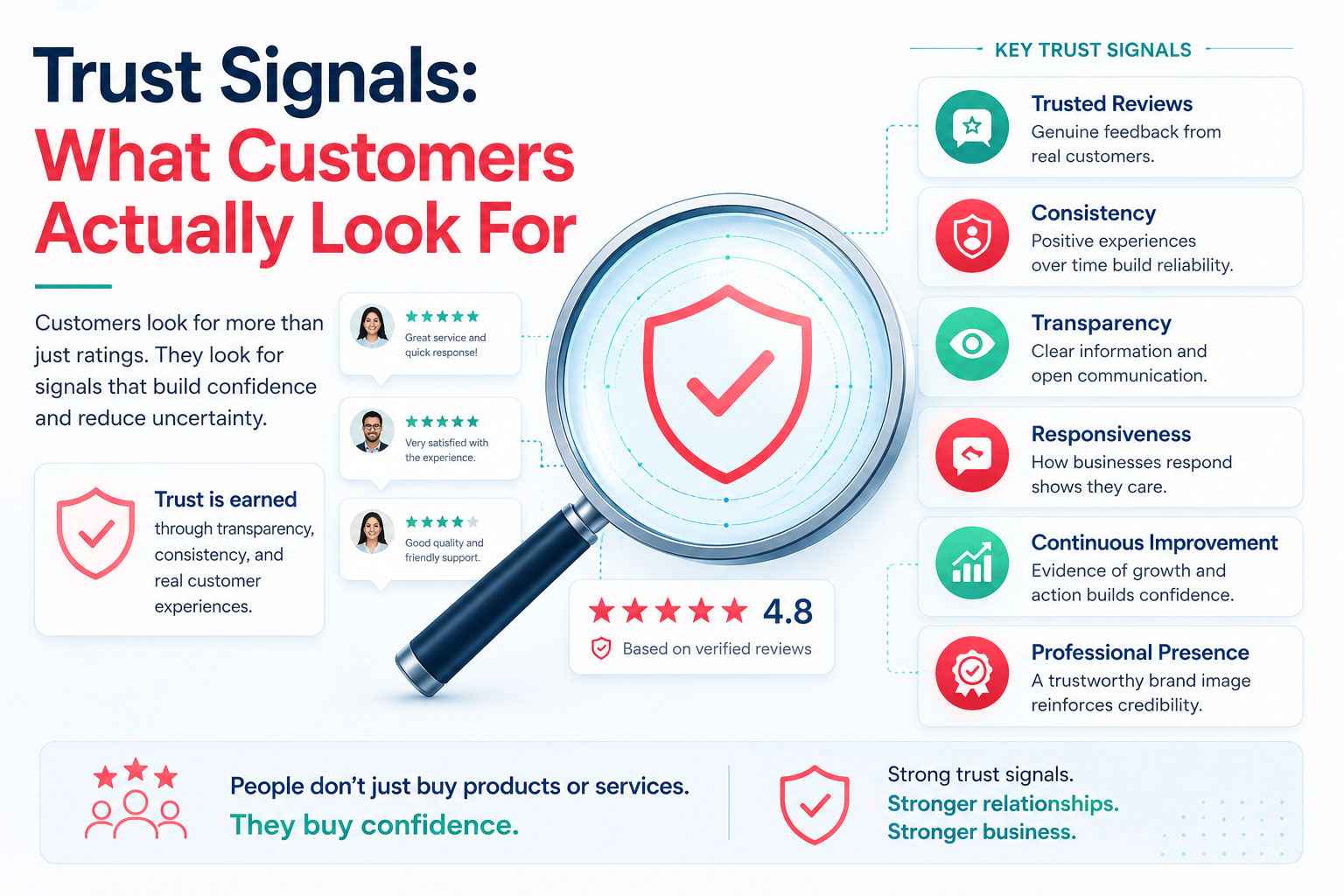
Customers rarely rely on a single piece of information. Instead, they evaluate a combination of indicators that together form a perception of credibility.
These signals may include:
- Customer reviews and feedback
- Overall reputation
- Consistency of customer experiences
- Transparency in communication
- Responsiveness to concerns
- Professional presentation and brand presence
The stronger and more consistent these signals become, the easier it is for customers to develop confidence.
The Role of Trusted Reviews
Customer reviews remain one of the most influential trust signals available today.
People often want to understand how others have experienced a business before making a commitment themselves. Reviews provide valuable context that advertising and marketing messages cannot always offer.
However, the effectiveness of reviews depends on their credibility.
Trusted reviews carry significantly more value because they help customers distinguish authentic experiences from unreliable information. The focus is not simply on collecting feedback but on creating confidence in the feedback itself.
Consistency Builds Confidence
Customers pay attention to patterns.
A single positive review can be encouraging, but a consistent history of positive experiences creates much stronger credibility. Likewise, repeated concerns often carry more weight than isolated complaints.
Consistency signals that a business can reliably deliver on its promises.
Over time, consistent performance becomes one of the strongest indicators of trustworthiness.
Transparency as a Trust Signal
Transparency has become increasingly important in modern decision making.
Customers want to understand how businesses operate, how feedback is handled, and how reputation is established.
Transparent organizations are more likely to earn trust because they demonstrate openness rather than attempting to control perception.
This includes:
- Clear communication
- Visible customer feedback
- Honest responses to criticism
- Accessible information about products and services
Transparency does not require perfection. It requires visibility and accountability.
Responsiveness Demonstrates Commitment
How a business responds to customers can be as important as the feedback itself.
Customers notice when organizations acknowledge concerns, answer questions, and engage constructively with feedback.
Responsiveness signals that a business values its customers and is committed to continuous improvement.
A reputation is strengthened not only by positive experiences but also by how challenges are addressed when they occur.
Why Context Matters More Than Ratings Alone
A rating provides a summary, but context provides understanding.
Customers increasingly look beyond scores to evaluate:
- Recent feedback trends
- Customer sentiment
- Review quality
- Business responses
- Evidence of improvement over time
This shift reflects a growing preference for meaningful reputation signals instead of simple numerical averages.
The Growing Role of AI in Trust Signals
Artificial intelligence is beginning to play a larger role in helping customers and businesses understand reputation.
AI can identify patterns, detect trends, and uncover insights that may not be immediately visible through individual reviews alone.
When combined with authentic customer feedback, AI can help create a clearer picture of overall credibility.
The goal is not to replace customer experiences but to help interpret them more effectively.
Where Trustaine Fits In
Trustaine is built around the idea that trust should be supported by meaningful and transparent signals.
The platform combines trusted customer feedback, evolving reputation systems, and AI-informed insights to help businesses and consumers make more informed decisions.
Through AI-informed baseline ratings and continuously evolving customer feedback, Trustaine helps transform reputation into a living reflection of real experiences.
This approach allows credibility to develop through evidence rather than assumption.
Building Trust Through Evidence
Customers are not looking for perfection. They are looking for confidence.
The businesses that earn trust most effectively are those that provide clear signals of credibility through transparency, consistency, accountability, and authentic customer experiences.
As digital decision making continues to evolve, trust signals will become increasingly important in helping customers navigate an increasingly complex marketplace.
Organizations that understand and strengthen these signals will be better positioned to build lasting credibility and stronger relationships with the people they serve.